
Case study
Holten Canadian War Cemetery Visitor Centre
A permanent gallery-screen exhibit that follows the units of the men buried here back across the campaign that killed them.
1,394 graves, and one date each
Holten Canadian War Cemetery holds 1,394 war graves on the Holterberg, 1,355 of them Canadian. Most of these men were killed in the last six weeks of the war — the advance through the eastern Netherlands and across the Ems into Germany, in April and the first days of May 1945.
A headstone gives a visitor three facts: a name, a unit, a date. Everything that leads up to that date — where the unit had fought in the autumn, which rivers it crossed in February, what the week before the date looked like on the ground — sits in the war diaries. The war diaries were not in the gallery.
What families arrive asking
Since 2011 the Information Centre has told the story of the men buried here through personal accounts, photographs and film, kept going by more than 120 volunteers. That work answers who was he. The question that follows is almost always geographic: where was he before this?
A guide can trace that path for the soldiers whose files they know by heart. Nobody can trace it for 1,394 men at once. Not without the diaries, and not without a map.
What we built
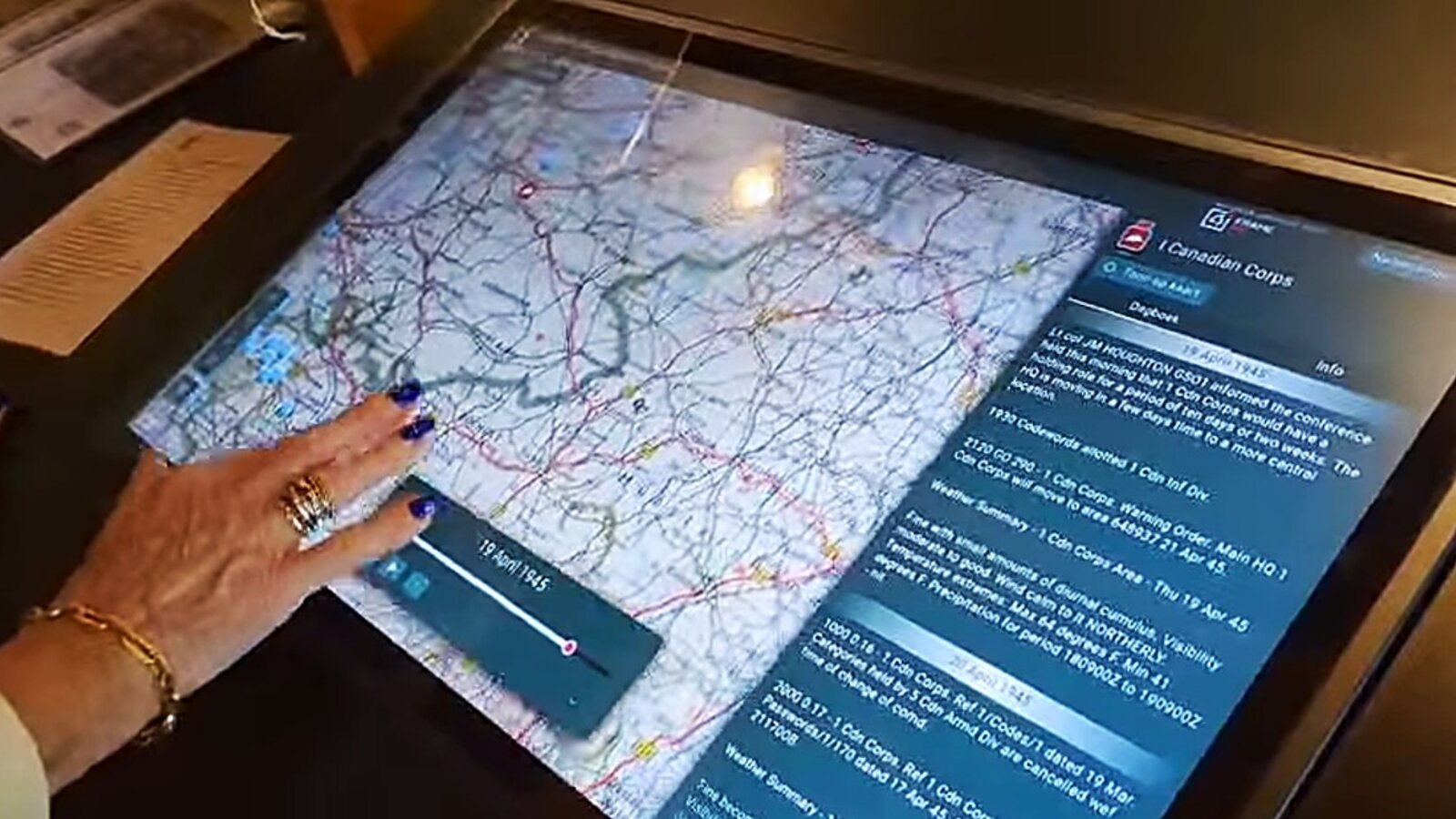
A gallery-screen kiosk in the visitor centre runs a war diary exhibit built on Frame 44 Atlas, covering the campaign from September 1944 to the end of the war in May 1945.
The map holds 108,000 mapped unit positions, dated day by day. Beside them sit the war diary entries those positions come from — 10,000 pages of the units' own record, sourced and readable as it was written. A visitor takes the unit from a headstone, finds it on the map, and moves back through the campaign with the diary open next to the ground it describes.
None of it was researched for Holten. The positions were already mapped and the diaries already transcribed, in an archive our historians have spent years building. That is what the archive is for. The centre did not have to fund a research programme and wait years for the result — it decided what its visitors needed, and we built the exhibit from a record that already existed.
Two minutes at the screen
A visitor comes in from the cemetery holding a plot number and a regimental name. Say it is The Queen's Own Rifles of Canada. They put the unit on the map and pull the date backwards from the one on the headstone: Deventer, April 1945. Then the week before that, then the month before that — with the diary entry for each of those days there to read.
The stone says where he stopped. The screen says where he had been. Most visitors who start that are still standing there several minutes later.
The specifications
| Installation | Permanent gallery-screen kiosk, visitor centre |
|---|---|
| Screen | One 32-inch 1080p touchscreen, mini PC |
| Exhibit type | War diary exhibit on Frame 44 Atlas |
| Period covered | September 1944 – May 1945 |
| Mapped positions | 108,000 |
| War diary pages | 10,000 |
| Languages | English and Dutch |
| Sources | Library and Archives Canada; Canadian Research and Mapping Association |
| Running since | April 2026 |
| Museum website | canadesebegraafplaatsholten.nl |
If you are planning something similar
This installation began as a conversation about one question the record could not answer on its own. Tell us what your visitors arrive asking, and we will tell you which part of the archive answers it.